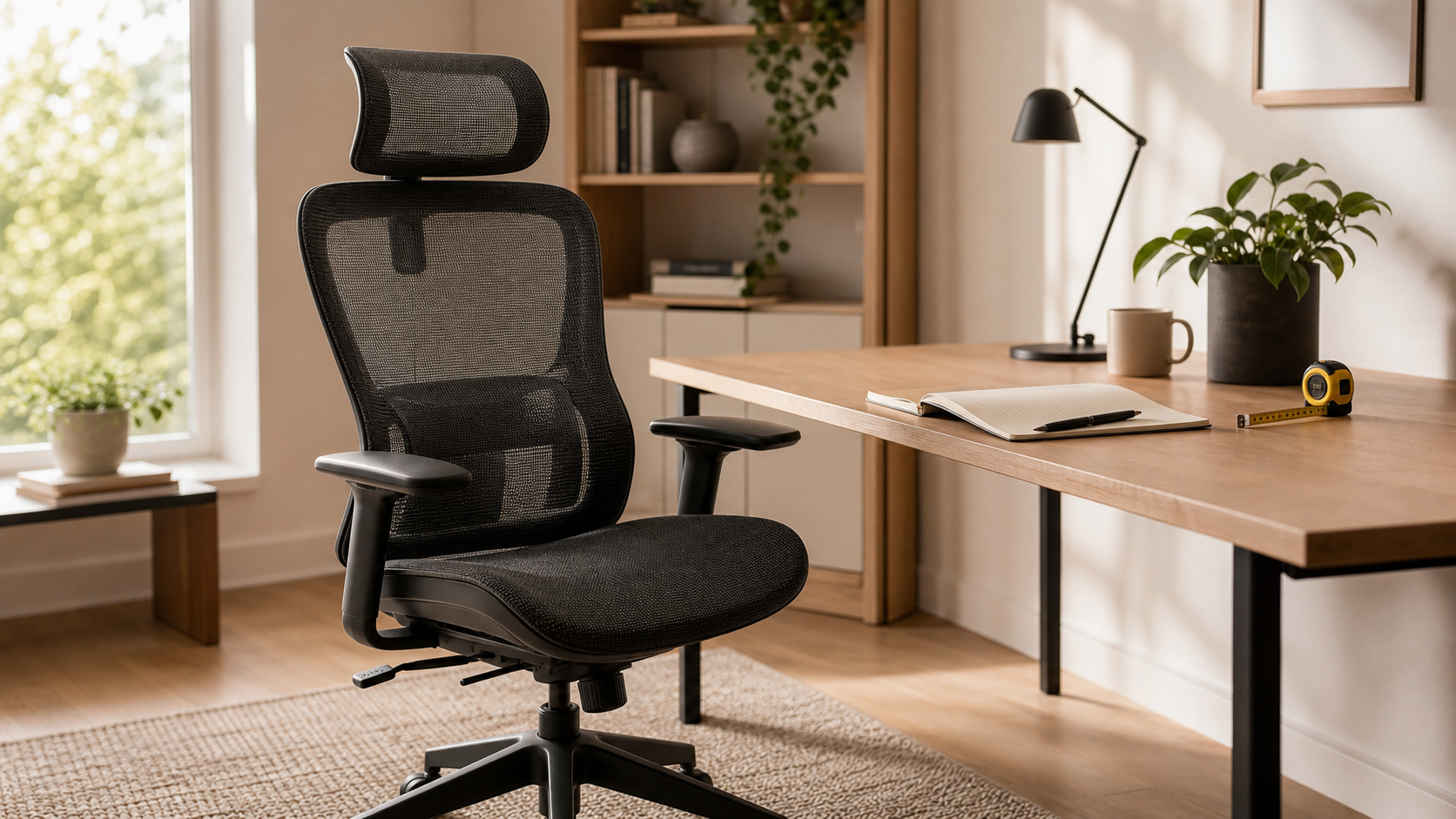
This comparison covers a Branch Verve path, a Steelcase Leap adjustment path, and a Herman Miller Aeron sizing path. These are comparison examples and not proof that a specific Amazon listing fits a particular person.
Illustrative chair workspace only — not a product photo, tested chair, or endorsement.
Evidence disclosureBestOnAmz did not personally sit in or test these chairs. This guide separates published fit and warranty material, attributed independent evaluations, marketplace identity checks, and the limits of the available record.
Choose the question first
Three records for three different chair decisions.
Read the documented fit, adjustment, or sizing path first. The model name, a review quote, or a marketplace listing cannot establish your individual fit.
Compare the seat and arm adjustments you need, then check size and purchase terms. The Verve link identifies a Galaxy configuration; Leap and Aeron links still open model searches.
New-chair starting path
Branch Verve Chair
Published question: Does your reference seat setting fall within the documented 16.5–20.5 inch seat-height and 16.5–19 inch seat-depth ranges? If arm-pad position is the constraint, height adjustment alone may not solve it.
Pause and verify: The direct button identifies the Galaxy configuration, not every color or a headrest bundle. Verify the included parts, condition, seller and written return/warranty terms. Matching dimensions do not guarantee comfort.
Published question: Which published adjustments matter for your task, and can you verify the condition, included options, and coverage for the exact marketplace result?
Pause and verify: New, used, renewed, and refurbished offers can differ materially in condition, options, return rights, and warranty coverage.
Published question: Have you used the official size-fit material and identified the tilt, arm, lumbar, condition, and purchase-channel details that apply to the exact result?
Pause and verify: Size, selected options, age, condition, seller, return rights, and warranty route vary across marketplace listings.
Compare the Verve when adjustable seat depth and a fabric-covered foam seat fit your routine. Its arms adjust in height; do not assume the fore/aft positioning available on some more adjustable chairs.
Source checked August 2, 2026. Any attributed independent evaluation is publisher reporting, not BestOnAmz hands-on testing.
Fit question to investigate
Does your reference seat setting fall within the documented 16.5–20.5 inch seat-height and 16.5–19 inch seat-depth ranges? If arm-pad position is the constraint, height adjustment alone may not solve it.
Check before buying
The direct button identifies the Galaxy configuration, not every color or a headrest bundle. Verify the included parts, condition, seller and written return/warranty terms. Matching dimensions do not guarantee comfort.
What the source record supports
Branch publishes a 16.5-20.5 inch seat-height range, 16.5-19 inch seat-depth range, and 275-pound capacity for the Verve Chair.
Branch publishes a seven-year parts-and-components warranty for a qualifying new Verve purchase, subject to its channel, geography, registration, and proof-of-purchase terms.
Source trail
Read the cited records before shopping. The Verve verification below identifies one configuration; the other records remain model-level context.
Verifying this Galaxy model does not establish your fit, the current condition, seller, delivered price, included accessories, return rights or warranty eligibility.
Seat depth and arm position solve different problems
October 15 listing inspection identifies Branch Verve, Galaxy, adjustable seat depth and armrest height. Manufacturer dimensions support the range check. Tom’s Guide reports that the arms do not move forward/backward; that is its review, not our test.
Branch currently offers a compatible headrest separately. The reviewed Galaxy listing pictures the chair without one; confirm included accessories before ordering.
If you need to move the arm pads toward or away from your keyboard, the Verve’s height adjustment does not provide that movement. Compare the documented Leap arm controls instead of assuming that six adjustment points include every direction.
Exact model and Galaxy color checked October 15, 2026. This is listing identity evidence, not a live price or warranty guarantee.
Affiliate disclosure: As an Amazon Associate I earn from qualifying purchases. Amazon links are optional; verify the exact chair size, configuration, condition, seller, return route, and warranty terms yourself. How affiliate links work
Steelcase documents multiple adjustment controls for the Leap. Use those official controls and specifications to assess whether a more adjustable chair warrants further comparison.
Source checked August 2, 2026. Any attributed independent evaluation is publisher reporting, not BestOnAmz hands-on testing.
Fit question to investigate
Which published adjustments matter for your task, and can you verify the condition, included options, and coverage for the exact marketplace result?
Check before buying
New, used, renewed, and refurbished offers can differ materially in condition, options, return rights, and warranty coverage.
What the source record supports
Steelcase describes height-adjustable lumbar support and lower-back firmness, four-direction arms, adjustable recline resistance, and four recline-stop positions for Leap configurations.
The reviewed source record does not identify the condition, installed options, return route, or warranty coverage of a marketplace offer; those must be verified on the exact result.
Source trail
Read the cited records before shopping. The Verve verification below identifies one configuration; the other records remain model-level context.
That an Amazon result is a specific Leap configuration, is new rather than used or refurbished, or has the seller, return route, and warranty coverage you need.
Affiliate disclosure: As an Amazon Associate I earn from qualifying purchases. Amazon links are optional; verify the exact chair size, configuration, condition, seller, return route, and warranty terms yourself. How affiliate links work
Open Amazon model search Affiliate link; this opens Amazon search results rather than a verified single product page.
Sizing-first path
Herman Miller Aeron
Herman Miller publishes an Aeron size-fit reference and buying guidance. Use the size and configuration record before treating the model name as a complete purchase decision.
Source checked August 2, 2026. Any attributed independent evaluation is publisher reporting, not BestOnAmz hands-on testing.
Fit question to investigate
Have you used the official size-fit material and identified the tilt, arm, lumbar, condition, and purchase-channel details that apply to the exact result?
Check before buying
Size, selected options, age, condition, seller, return rights, and warranty route vary across marketplace listings.
What the source record supports
Aeron is offered in three sizes; Herman Miller's current size-fit material should be used before treating the model name as a complete fit decision.
Herman Miller states a 12-year parts-and-labor warranty for qualifying purchases, with eligibility dependent on the seller and written warranty terms.
Source trail
Read the cited records before shopping. The Verve verification below identifies one configuration; the other records remain model-level context.
That an Amazon result has the right Aeron size, generation, tilt, arms, lumbar option, condition, seller, return rights, or Herman Miller warranty eligibility.
Affiliate disclosure: As an Amazon Associate I earn from qualifying purchases. Amazon links are optional; verify the exact chair size, configuration, condition, seller, return route, and warranty terms yourself. How affiliate links work
Open Amazon model search Affiliate link; this opens Amazon search results rather than a verified single product page.
Measure the chair decision
Comfort reports can identify patterns, but they cannot establish an individual outcome. Published dimensions, adjustment range, purchase channel, and return rights deserve equal weight.
Body fit
Match seat height, seat depth, and back format to your measurements and workspace; brand reputation cannot establish individual fit.
Adjustment
Begin with the controls that address a real setup question. More controls are useful only when they solve a documented mismatch.
Source boundary
Manufacturer records establish published specifications and warranty terms. Attributed external evaluations are not universal outcomes or BestOnAmz testing.
Purchase channel
New, open-box, used, renewed, and refurbished listings can carry different parts, service, returns, and warranties.
Health boundary
No chair is medical care or a treatment. A buying guide can discuss setup questions but cannot diagnose, treat, or promise pain relief.
Apply the published range in three steps
1. Record a reference. On a chair and at a desk that currently work for you, note the set seat height (floor to the top of the seat) and usable seat depth (back of the seat to its front edge).
2. Compare like with like. Check each reference number against the documented range for the exact chair and configuration; a chair’s overall height is not its seat-height range.
3. Keep the decision conditional. A matching range is a reason to investigate, not proof of fit. Confirm the exact listing’s size, controls, condition, return route, and warranty terms.
Worked range check: Branch Verve
If a suitable current setup measures 18 inches at the seat and 17.5 inches of usable seat depth, both numbers fall inside Branch’s published Verve ranges: 16.5–20.5 inches for seat height and 16.5–19 inches for seat depth. That arithmetic only shows that the documented ranges include those reference settings; it does not establish individual fit or the configuration of a marketplace result.
Seat-depth adjustment does not move the arm pads forward or backward. If that is your constraint, compare arm movement separately before choosing the Verve.
The Aeron path is different: Herman Miller asks the buyer to choose among Size A, B, and C using its size-fit material. Treat that selected size as a model choice, not as a substitute for the Verve’s adjustable seat-depth comparison, and verify the exact size and options on any listing.
This guide does not make medical claims or promise pain relief. Persistent pain or functional limitations require advice from a qualified professional, not an affiliate buying guide.