KitchenAid Artisan or Hamilton Beach 63391?
Choose a stand mixer for the baking you actually do
Start with your usual recipe and where the mixer will live. Compare the 5-quart Artisan if optional powered attachments are part of your plan. Compare the 4-quart Hamilton Beach if you want the basic mixing tools in a straightforward package.
By BestOnAmz Research Desk · Last reviewed
Compare the options ↓The decision at a glance
The Artisan gives you a larger nominal bowl and an optional attachment system. The Hamilton Beach gives you a smaller bowl and the core beater, hook and whisk. Choose by the jobs you need, then check the actual price gap. Neither bowl volume nor motor watts establishes a heavy-dough winner.
| Buying decision | KitchenAid Artisan KSM150PSER | Hamilton Beach 63391 |
|---|---|---|
| Bowl | 5-quart stainless steel | 4-quart stainless steel |
| Head access | Tilt-head | Tilt-back head with top handle |
| Speed settings | 10 | 7 |
| Included mixing tools | Flat beater, dough hook, wire whip | Flat beater, dough hook, whisk |
| Shield | Pouring shield included | Splash guard included |
| Main reason to compare | Optional hub-powered accessories | Core mixing package without an accessory plan |
Scroll the table horizontally on a small screen.
The models we would compare
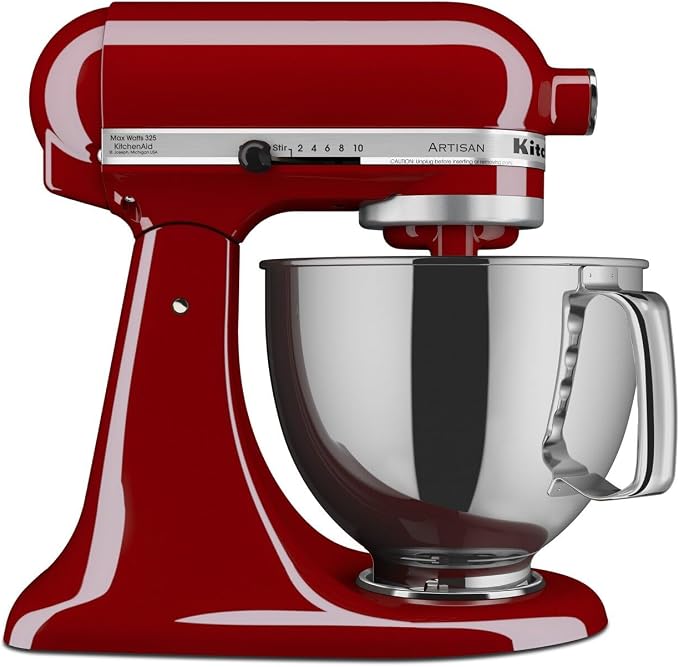
01 / For an attachment-based kitchen setup
KitchenAid Artisan 5-Quart
KSM150PSER · Empire Red
The starting point here if you want the mixer to power separately purchased kitchen attachments.
- 5-quart bowl with handle
- 10 speed settings
- Optional hub-powered accessories
The trade-off: Optional accessories add to the total. This is a tilt-head Artisan, not a bowl-lift mixer or a commercial dough machine.
View KitchenAid Artisan 5-Quart on AmazonWhy we would choose it
We would compare the Artisan when you can name the accessory you will use or want its larger bowl. If you only need a basic beater and whisk, check whether those advantages justify the current price difference.
What the manufacturer documents
KitchenAid lists the bowl, coated beater, coated dough hook, wire whip and pouring shield. Hub-powered accessories are optional. These specifications establish the package, not a longevity or kneading-performance advantage.
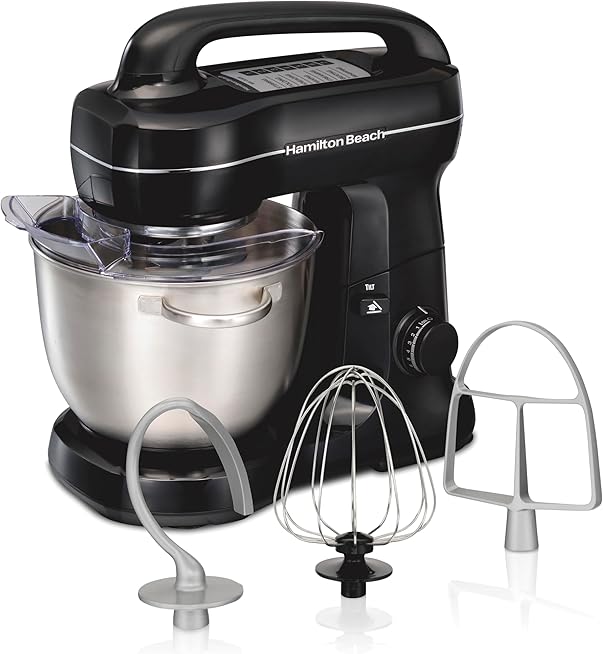
02 / For a core mixing setup
Hamilton Beach 7-Speed
63391 · Black · 4-quart
A straightforward option to compare when your shopping list is a bowl, beater, hook and whisk.
- 4-quart bowl with handles
- 7 speeds and top-mounted speed guide
- Carry handle and included splash guard
The trade-off: Do not transfer features from Hamilton Beach 63390, Stack & Scrape or hand/stand models. Check 63391 on the offer.
View Hamilton Beach 7-Speed on AmazonWhy we would choose it
Compare this when you want the included mixing tools and do not have a powered-accessory plan. Confirm that your usual recipe fits the manual’s limits; a low checkout price cannot fix an unsuitable batch size.
What the manufacturer documents
Hamilton Beach identifies model 63391, its 4-quart bowl, seven speeds, tilt-back head, handle and included tools. Its performance language is manufacturer marketing; we have not tested it against the Artisan.
Start with your most common recipe
Write down the recipe you make most often, its ingredient quantities and whether you normally double it. Check the exact mixer’s manual against that recipe before ordering. Nominal bowl volume is useful for comparing packages, but it is not a universal dough or flour limit.
If cakes, frosting and occasional cookies are your routine, compare the included tools and the actual offers first. For frequent stiff dough or repeated large batches, broaden the shortlist to models with documented limits for that work. Neither product here earns a heavy-bread recommendation from its specifications alone.
Buy an accessory system only if you will use it
For the Artisan, list the optional accessory you want and add its price to the mixer. Compare that complete setup with a separate appliance that does the same job. Check the accessory’s compatibility for this exact mixer before buying.
If no accessory comes to mind, make the decision on the mixer you need today. A future pasta-making plan should not outweigh the practical questions of bowl size, storage and whether the current offer fits your budget.
Plan space for opening the head
Measure the counter and storage space before ordering, and check the manufacturer dimensions for the selected model. Both mixers open upward for access: leave room above and behind the machine to raise the head and remove the bowl. A closed-height measurement alone does not establish under-cabinet usability.
Decide whether you will keep it on the counter or move it for each bake. The Hamilton Beach has a top handle, but you should still check the lift and storage route. A machine that is awkward to retrieve may get less use than expected.
Check the package, not just the brand
The selected Artisan package includes a pouring shield; the old assumption that you must buy one separately does not apply to this configuration. The selected Hamilton Beach includes a splash guard. Photographs of other bundles are not proof of your offer’s contents.
Before checkout, verify model number, voltage, condition, seller, included tools and return terms. Treat refurbished offers and accessory bundles as different purchases. Use the current delivered total rather than an old price range or a claimed discount.
Before buying
Which is better for bread dough?
We cannot name a tested winner. Check recipe quantities, kneading instructions and operating limits in the exact manual. Bowl capacity and wattage are not interchangeable with dough capacity.
Does the Artisan include a pouring shield?
KitchenAid lists a pouring shield in the KSM150PS package checked here. Confirm the included items on the selected offer, particularly for used or refurbished units.
Will the larger bowl work better for a tiny batch?
Larger nominal capacity does not establish better performance with small quantities. If small batches are your main use, look for exact-model evidence for those quantities before buying.
Is the Hamilton Beach always cheaper?
No fixed price relationship is promised. Compare the current delivered totals for equivalent condition and included tools.
Source trail
Reviewed October 11, 2026. Amazon titles were checked for Empire Red Artisan KSM150PSER and black Hamilton Beach 63391. Product images were matched to the selected models. Manufacturer sources support model identity and package contents. This is a researched package-and-workflow comparison, not hands-on mixing, noise, durability or kneading testing. No invented ratings, delivery claims or fixed prices.
Manufacturer and independent-review links appear beside each model. These are researched recommendations; we have not personally tested these products. Product images may contain brand marketing and awards, which are not our findings. Two identified tilt-head mixers for different buying priorities, not a market-wide performance ranking. We omit unverified prices, star ratings and delivery promises. How we research · Amazon listing checklist