Two different ways to light a picture
OLED vs QLED: buy for the room, not the label
Choose OLED for dark-scene precision and wider seating. Consider a well-tested Mini-LED QLED for bright daytime viewing or long sessions of static content. The exact model still matters more than the badge.
By BestOnAmz Research Desk · Last reviewed
Compare the options ↓The decision at a glance
OLED pixels produce their own light; QLED describes quantum-dot color in an LCD television with a separate backlight. Mini-LED describes that backlight, so a television can be both QLED and Mini-LED. Compare the screen design and tested behavior together.
| Your priority | OLED direction | QLED / Mini-LED direction |
|---|---|---|
| Dark films and subtitles | Pixel-level light control avoids backlight halos | Local dimming can help, but halos depend on the model |
| Seats across a wide sofa | C5 is our example to compare for side seats | Check the exact LCD viewing-angle test |
| Daytime viewing | A bright OLED can work; inspect reflections | U8QG is an example for indirect room light |
| Static scoreboards or desktop use | Consider cumulative burn-in risk | LCD avoids the OLED-specific burn-in trade-off |
| Gaming | Check ports, VRR and motion at your frame rate | The QLED badge alone says nothing about gaming quality |
Scroll the table horizontally on a small screen.
The models we would compare
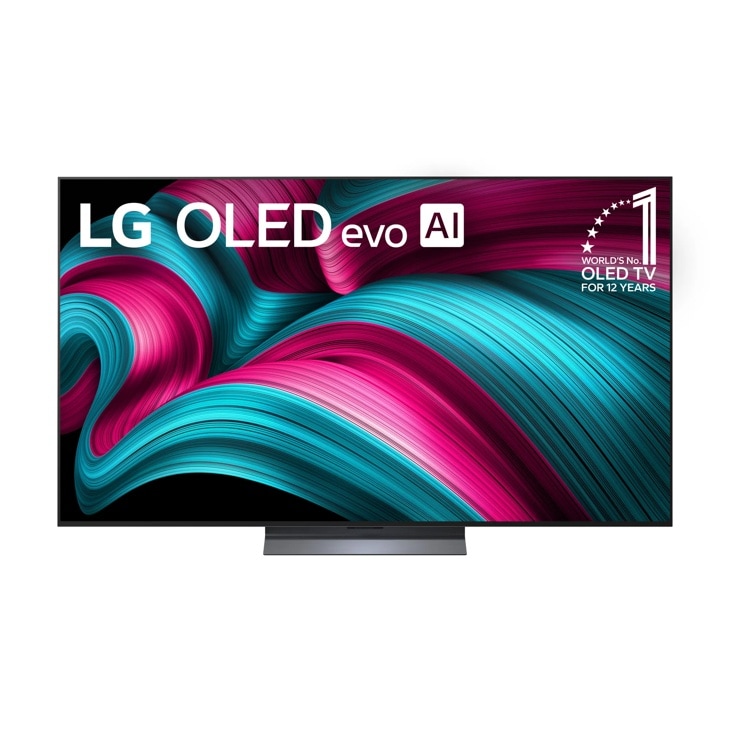
01 / OLED example: films and wider seating
LG C5 OLED
OLED65C5PUA · 65-inch · 2025
The balanced OLED choice for a living room that does a bit of everything: films, streaming, sport and console games.
- OLED black levels without backlight halos
- Wide viewing angle for a sofa with side seats
- Four HDMI 2.1 inputs; up to 4K/144Hz with a compatible PC
The trade-off: Direct window reflections remain visible. Consider OLED burn-in risk if you display the same static graphics for long periods.
View LG C5 OLED on AmazonWhy we would choose it
Our OLED starting point for evening films and a sofa with side seats. Compare its actual offer with the Mini-LED alternative rather than assuming every OLED is the expensive choice.
What the research says
RTINGS tested the 65-inch C5 and reports strong contrast, wide viewing angles and responsive gaming. It also notes film stutter and distracting direct reflections.
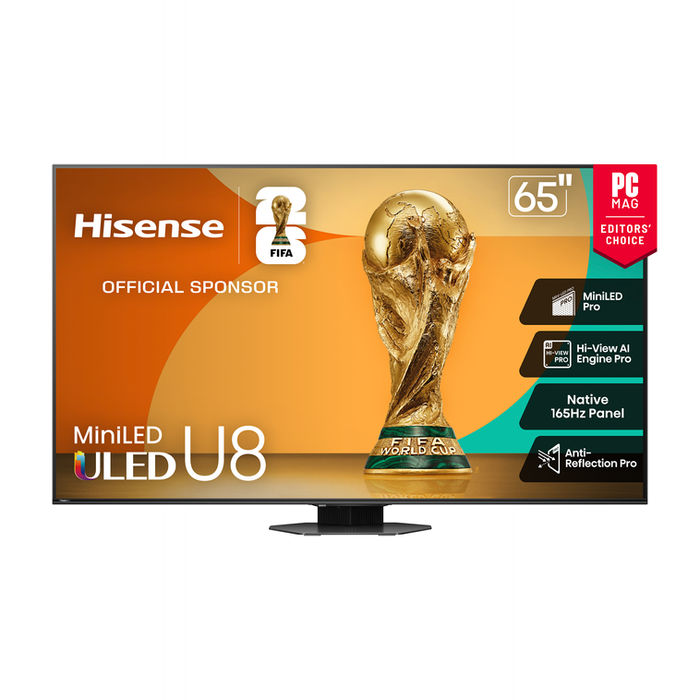
02 / QLED Mini-LED example: indirect daylight
Hisense U8QG
65U8QG · 65-inch · 2025
A bright Mini-LED alternative for daytime viewing when your seats are mostly in front of the screen.
- High brightness for rooms with indirect daylight
- Mini-LED backlight with local dimming
- Google TV; three HDMI 2.1 inputs and up to 4K/165Hz
The trade-off: Less consistent from the sides, with blur in fast motion. Brightness does not eliminate direct reflections or backlight blooming.
View Hisense U8QG on AmazonWhy we would choose it
Our LCD example when daytime brightness and central seating drive the decision. Its local dimming does not make it equivalent to OLED pixel-level light control.
What the research says
RTINGS tested 65 inches and reports high brightness, but narrower viewing angles and slower pixel transitions. Its USB-C display input lacks VRR; use HDMI for that feature.
What changes when you turn the lights down?
In a dark film, the useful question is whether bright subtitles or stars illuminate nearby black areas. OLED can switch individual pixels off. An LCD controls a backlight in larger areas, even when the LEDs are very small. That is why a Mini-LED label does not promise halo-free subtitles.
If you mostly watch news and casual streaming with room lights on, that distinction may matter less to you than screen placement, operating system and total cost. Do not pay for a strength you rarely notice.
Room light and seating can reverse the choice
A blanket rule that QLED wins every bright room is too crude. The G5 in our broader shortlist is a brighter OLED alternative, while an entry-level QLED may handle reflections poorly. A reflected window needs a reflection test; a generally washed-out daytime picture needs a brightness assessment.
Look from your actual side chair as well as the center seat. A screen can look excellent head-on and lose contrast from the end of a sectional. Match the model to the seats you use, not just the diagonal size.
Gaming and static content are separate decisions
For a console, verify 4K/120Hz and VRR on the inputs you will use. A PC may support higher frame rates, but that only helps with compatible hardware and games. Refresh-rate advertising does not tell you how clear moving objects look.
Repeated fixed graphics are a separate OLED consideration. A desktop taskbar or the same channel logo for long periods deserves more attention than varied films and games. We cannot promise a safe number of hours or predict an individual panel lifespan.
Before buying
Is QLED the same as OLED?
No. These QLED examples use an LCD and a backlight. OLED is self-emissive. Similar names do not imply the same black-level control.
Does Mini-LED automatically beat OLED?
No. It describes a backlight design, not a complete picture-quality ranking. Compare local dimming, reflections, viewing angle and motion on the exact model.
Which technology is cheaper?
Check matched size, condition and current offers. Clearance and bundles can change the comparison; neither badge guarantees the lower delivered price.
Should I choose a 2025 or 2026 model?
Compare the exact replacement and its tested improvements with the actual price difference. These examples are named 2025 models, not a ranking of every current release.
Source trail
Reviewed October 11, 2026. Manufacturer documentation establishes the selected model and panel features; RTINGS supplies independent behavior assessments. C5 and U8QG were tested at 65 inches. The technology explanation is a decision framework, not a claim that every OLED or QLED behaves like these examples.
Manufacturer and independent-review links appear beside each model. These are researched recommendations; we have not personally tested these products. Product images may contain brand marketing and awards, which are not our findings. These are identified 2025 models, not a claim to cover every 2026 release. We omit unverified prices, star ratings and delivery promises. How we research · Amazon listing checklist